

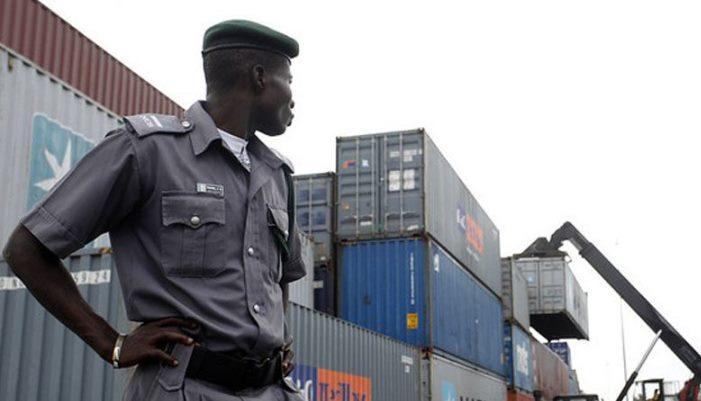
The Nigeria Customs Service, Federal Operations Unit Zone C, busted a consignment of dry donkey skin worth N3.6 billion in Owerri.
The goods conveyed in a 40 ft container were intercepted by the alert men of the Nigerian customs service, who noticed something fishy about the vehicle. The service issued a statement on the development explaining that donkey skin is on the export provision list, making it a prohibited item for trade and export.
“It was discovered that the items were packed in 10 pieces per sack and 9 pieces per sack, “totalling 3,022 pieces.“Each dry salted donkey skin has an average weight of 4.5kg, giving a total weight of 13.599 kilograms
A 40-ft containerized donkey skin billed for illegal export and worth about N3.6bn has been intercepted by vigilant officers of the Federal Operations Unit Zone C in Owerri,” the statement read in part.
The statement further broke down the mathematics of the consignment, revealing that Donkey skin stands at $750 and a unit price of $166.6 per kilogram. The Customs Area Controller in charge of FOU Zone C, Abdullahi Balogun, commended his men for the bust, extending words of affirmation to the Comptroller General of Nigerian Customs, Adewale Adeniyi.
Read More: Tinubu to Commission Concorde Hotel, Other Projects in Imo State
He extolled his commitment to revamping the customs service in the country and checkmating the activities of smugglers and illicit traders. Additionally, he warned Nigerians involved in the illegal trade of wildlife to desist from such acts, as the customs service is fully out to curtail such activity.
What to Know
- Donkey skin is primarily used to produce ejiao, a gelatin derived from boiling the hides, used in traditional Chinese medicine and cosmetics, believed to treat ailments like insomnia and enhance vitality, though lacking scientific support.
- The global trade, driven by Chinese demand, sees 4.8–6 million donkey skins traded annually, with the ejiao market valued at $7.8 billion in 2020, up from $3.2 billion in 2013.
- This trade devastates rural African communities, where donkeys are vital for livelihoods, leading to theft and economic hardship. In 2024, the African Union banned the trade to protect donkey populations and communities, though enforcement challenges persist.
