

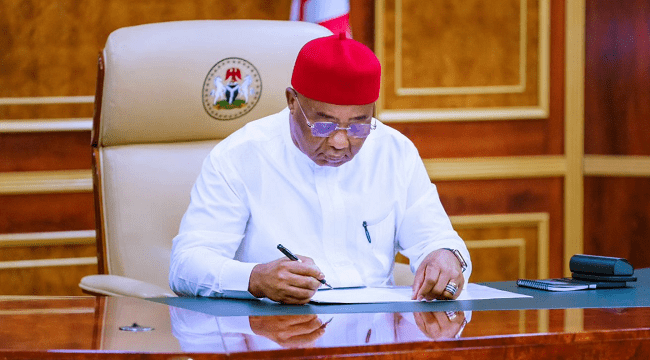
The Imo state government ordered the shutdown of unauthorized private schools in residential buildings, sensitizing parents in the state against sending their kids to such establishments.
The Directive passed by the Imo state commissioner for Primary and Secondary Education, Professor Bernard Ikegwuoha, mandates the shutting down of all private schools situated in apartments and housing estates not suitable for educational purposes. The development aims to reorganise and improve the education sector in the state.
“The Ministry of Primary and Secondary Education has, by this notification, revoked and withdrawn the approval and licenses of private schools that are presently housed and operating in apartments in Imo State,” the statement read.
Professor Ikegwuoha warned parents in the state against sending their wards to such schools, saying that such an act will lead to a forceful relocation of students to approved private schools in a proper educational setting.
“Proprietors of private schools in Imo State should note that failure to comply with the conditions outlined in this notice will result in punitive sanctions, including but not limited to immediate distribution of their pupils and students to nearby schools,” he said.
The Universal Basic Education Imo State Chapter unleashed members of its monitoring and inspection team, expected to enforce the new directive. The directive polarized opinions in the state, with a growing call for institutional support for Private schools.
Read Also: Abia Govt Panel Submits Probe Report on Suspended Provost
Educational stakeholders in the state also called for clear zoning guidelines in order to cushion the effect of the directive on the state’s educational system.
Imo State is a leader in Nigeria’s education, boasting a 96.43% literacy rate, driven by institutions like Imo State University. Recent challenges include dilapidated infrastructure and teacher shortages. The government’s 2025 initiatives aim to renovate schools and enhance digital learning, but critics demand more funding and accountability from the state government.
