

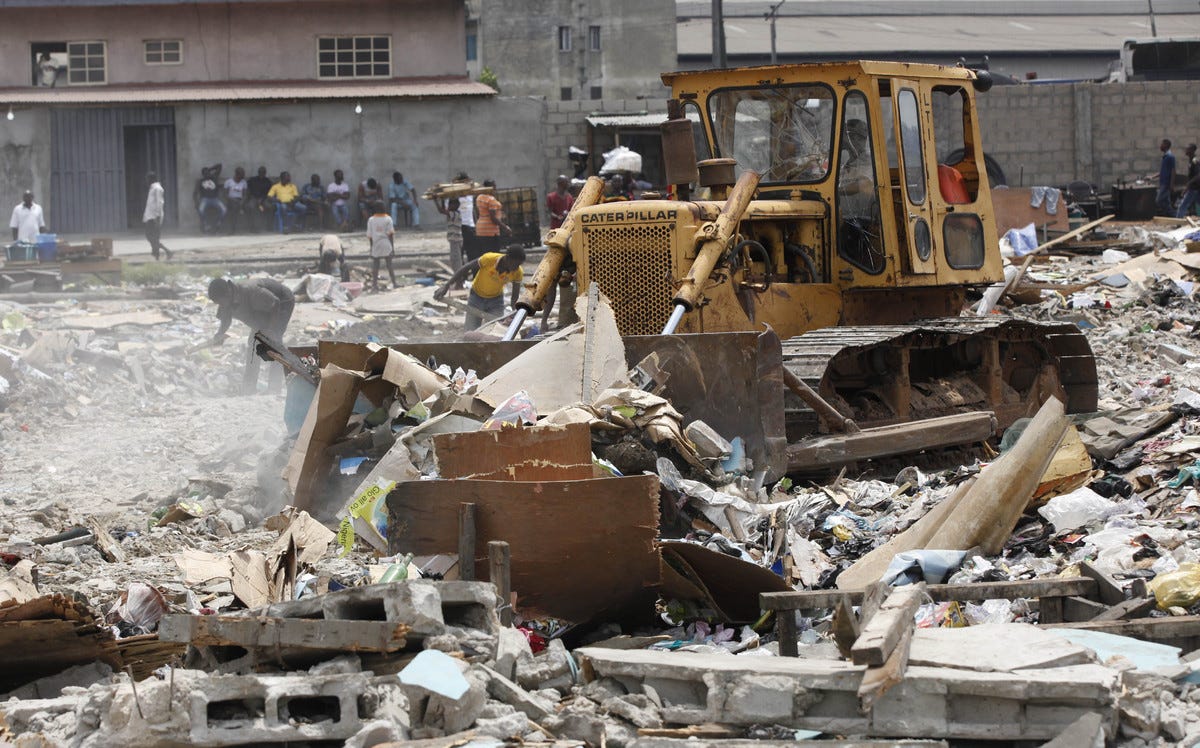
The Imo State government has demolished buildings under a 330KVA National Grid Transmission Corridor for safety reasons.
Affected communities include buildings in Ishiuzo Egbu, Umuawaka, and Awaka, all in Owerri North LGA. Amateur footage from an eyewitness showed a long line of demolished buildings across the state, confirming the government’s demolition exercise.
The general public has been warned repeatedly about erecting structures under power lines. The Enugu Electricity Distribution Company has repeatedly embarked on public sensitisation programs to discourage human activity beneath powerlines.
The order is usually flouted by individuals who grease the palms of regulatory agencies and erect structures in marjed areas. Similar demolitions have occurred in other states in Nigeria.
In early 2026, the Lagos and Edo state governments intensified “Operation Zero Tolerance,” demolishing thousands of structures in areas like Makoko, Ebute-Metta, and Benin City.
Government officials defend these actions as life-saving measures to prevent mass electrocution. Displaced residents argue that the demolitions are carried out with little notice and no resettlement plans, exacerbating homelessness among the urban poor.
Subsequent risks involved in the act include electrocution, as high-voltage cables can snap or sag, especially during rainstorms. In 2024 and 2025, several deaths were recorded in Lagos and Ogun states due to cables falling on shanties.
Other hazards include Long-term exposure to Electromagnetic Fields (EMF), which, according to some studies, is linked to neurological disorders, though many residents cite the immediate risk of fire as their primary fear.
Standard Practice by Nigeria’s regulatory body
The Nigerian Electricity Supply and Installation Standards (NESIS) mandate strict setbacks:
- 11kV/33kV lines: 5.5 meters to 11 meters.
- 132kV lines: 15 meters to 30 meters.
- 330kV lines: 25 meters to 50 meters.
The Imo state government did not give an official statement following its demolition exercise.
